Non-Destructive Testing Meets AI: Where CV Fits Into NDT
How computer vision fits into non destructive testing — which NDT methods produce images, where AI adds value, and how to keep experts in the loop.
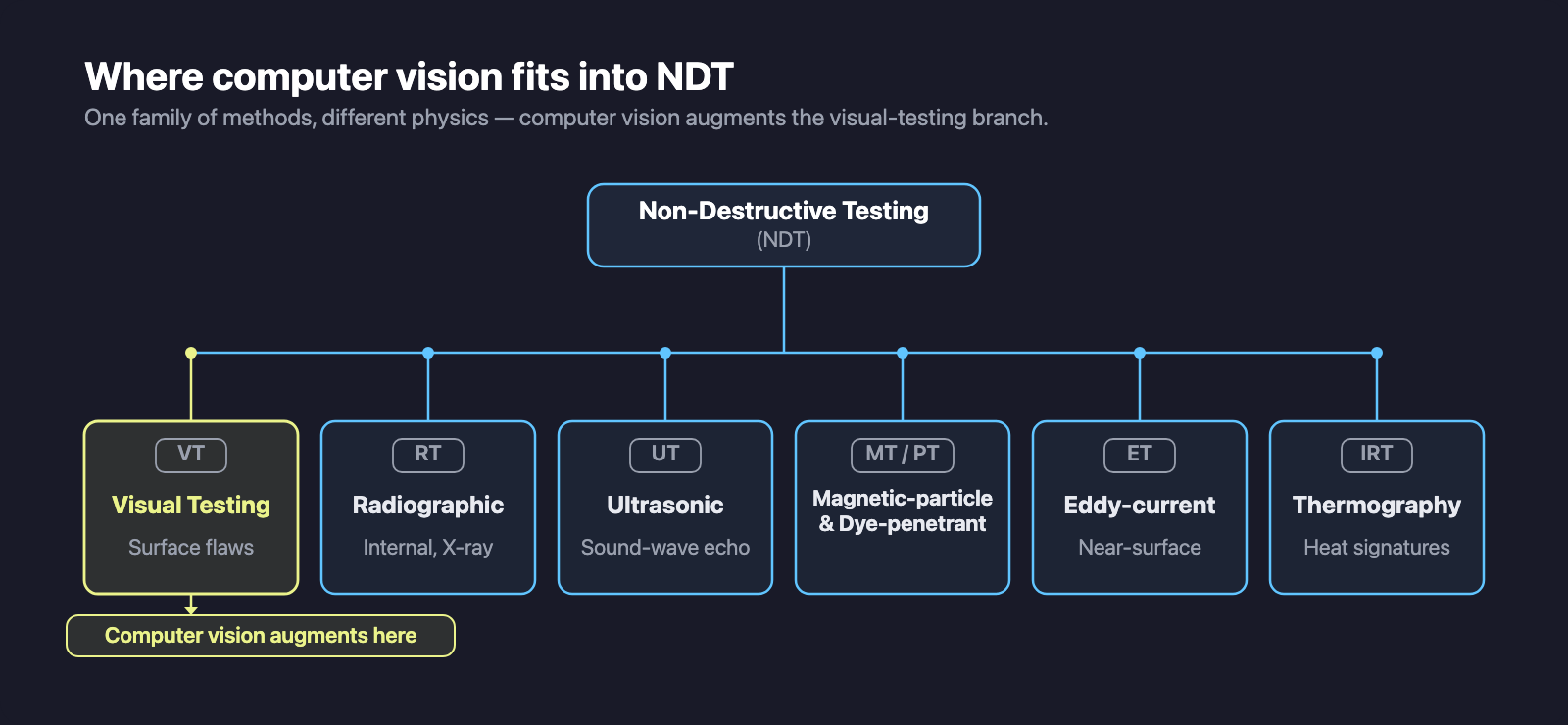
Non destructive testing (NDT) is the family of techniques engineers use to evaluate the integrity of a material, component or structure without damaging it. Because most NDT methods produce images, computer vision can take on the repetitive first pass while certified inspectors keep final judgement.
Non destructive testing (NDT) is the family of techniques engineers use to evaluate the integrity of a material, component or structure without damaging it. Most NDT methods — visual inspection, radiography, thermography, dye penetrant, magnetic particle — produce images, and images are exactly what modern computer vision is built to interpret. That overlap is where AI fits into NDT today: not replacing qualified inspectors, but taking on the repetitive first pass over thousands of frames so that expert judgement is spent where it matters. This guide maps the main NDT methods, shows where computer vision adds value to each, and sets out what a defensible, human-in-the-loop adoption path looks like for teams in nuclear, energy and infrastructure.
What is non destructive testing?
Definition: Non destructive testing (NDT) is the inspection, testing or evaluation of materials, components or assemblies for discontinuities or differences in characteristics without destroying the serviceability of the part. A component that passes NDT can go straight back into service.
NDT sits at the heart of asset integrity in safety-critical industries. In the UK, practitioner training and certification is governed by schemes such as PCN, run under the auspices of the British Institute of Non-Destructive Testing (BINDT), and aligned with ISO 9712, the international standard for qualification and certification of NDT personnel. Those frameworks matter for AI adoption too: any automated aid has to slot into a workflow where accountability ultimately rests with certified people.
What are the main types of non destructive testing?
There are dozens of specialised NDT methods, but most inspection programmes are built from a core set. (A dedicated deep-dive on types of non destructive testing is coming later in this series; here is the short version, with a note on how image-centric each method is.)
Visual testing (VT)
Visual inspection is the oldest and most widely used NDT method: an inspector examines a surface directly, via borescope, or through photographs and video. Drone surveys, ROV footage and fixed cameras have made VT overwhelmingly digital — which is why visual inspection NDT is the most natural entry point for computer vision. If your inspection output is already a folder of images, an AI baseline can be run against it with no change to how data is captured.
Radiographic testing (RT)
X-ray or gamma radiography reveals internal features — porosity, inclusions, lack of fusion in welds — as contrast variations on a radiograph. Digital radiography produces greyscale images that are, from a computer-vision standpoint, just another image modality. Automated screening of radiographs for weld indications is one of the most active areas of AI-assisted NDT.
Ultrasonic testing (UT)
UT sends high-frequency sound into a component and interprets reflections to find internal flaws and measure thickness. Conventional UT produces A-scan traces rather than images, but phased-array UT (PAUT) and time-of-flight diffraction (TOFD) produce 2-D scan images where computer vision techniques increasingly apply.
Magnetic particle inspection (MPI) and dye penetrant testing (PT)
MPI magnetises a ferromagnetic part and uses iron particles to reveal surface-breaking cracks; dye penetrant draws coloured or fluorescent dye into surface defects. Both methods end with a person looking at a visual indication — often under UV light — and both are routinely photographed, making the interpretation step amenable to image-based AI support.
Eddy current testing (ET) and thermography
Eddy current methods detect surface and near-surface flaws in conductive materials and are common in aerospace and heat-exchanger tubing. Infrared thermography images temperature differences to find delamination, moisture ingress or electrical hot-spots. Thermographic images in particular are a strong fit for the same detection and segmentation models used on visible-light imagery.
The pattern across all six: wherever an NDT method ends in an image that a human interprets, computer vision can support that interpretation.
Where does computer vision fit into the NDT workflow?
A typical inspection campaign has four stages: capture, screening, interpretation, and reporting. AI earns its keep mostly in the middle two.
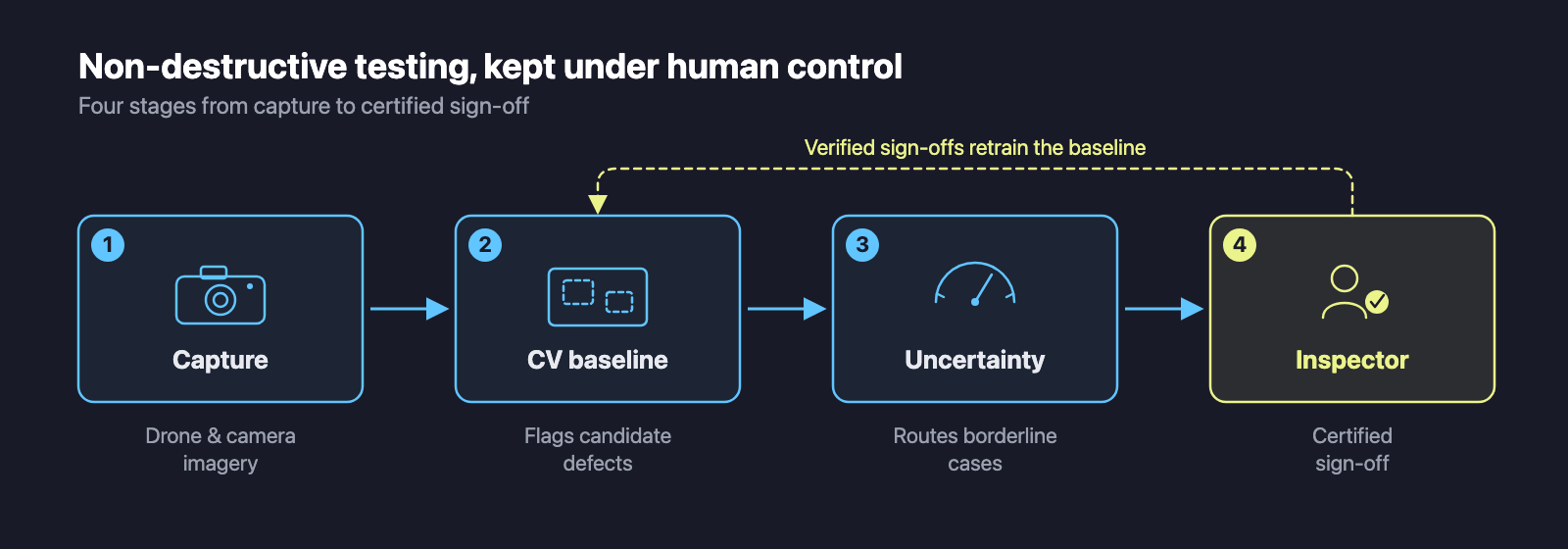
Screening at volume. A drone survey of a bridge deck, a pipeline CCTV run, or a batch of weld radiographs can produce thousands of images, most of which show nothing of interest. A detection model can triage the whole set in minutes, flagging frames with candidate indications — corrosion, cracking, porosity, coating breakdown — so inspectors start with a ranked shortlist rather than a haystack. Later posts in this series cover this in depth for surface defect detection and non destructive weld testing.
Consistent interpretation. Human visual inspection performance varies with fatigue, lighting and experience. A model applies the same criteria to image one and image ten thousand. That consistency doesn't replace an inspector's judgement — it gives that judgement a stable, auditable starting point, as we argued in our pillar guide to automated visual inspection.
Quantification. Computer vision can measure what humans estimate: corrosion area as a percentage of surface, crack length in pixels calibrated to millimetres, counts of indications per weld. Quantified outputs feed directly into engineering assessment and trend analysis across inspection campaigns.
The three problems that stall AI in NDT — and how to solve them
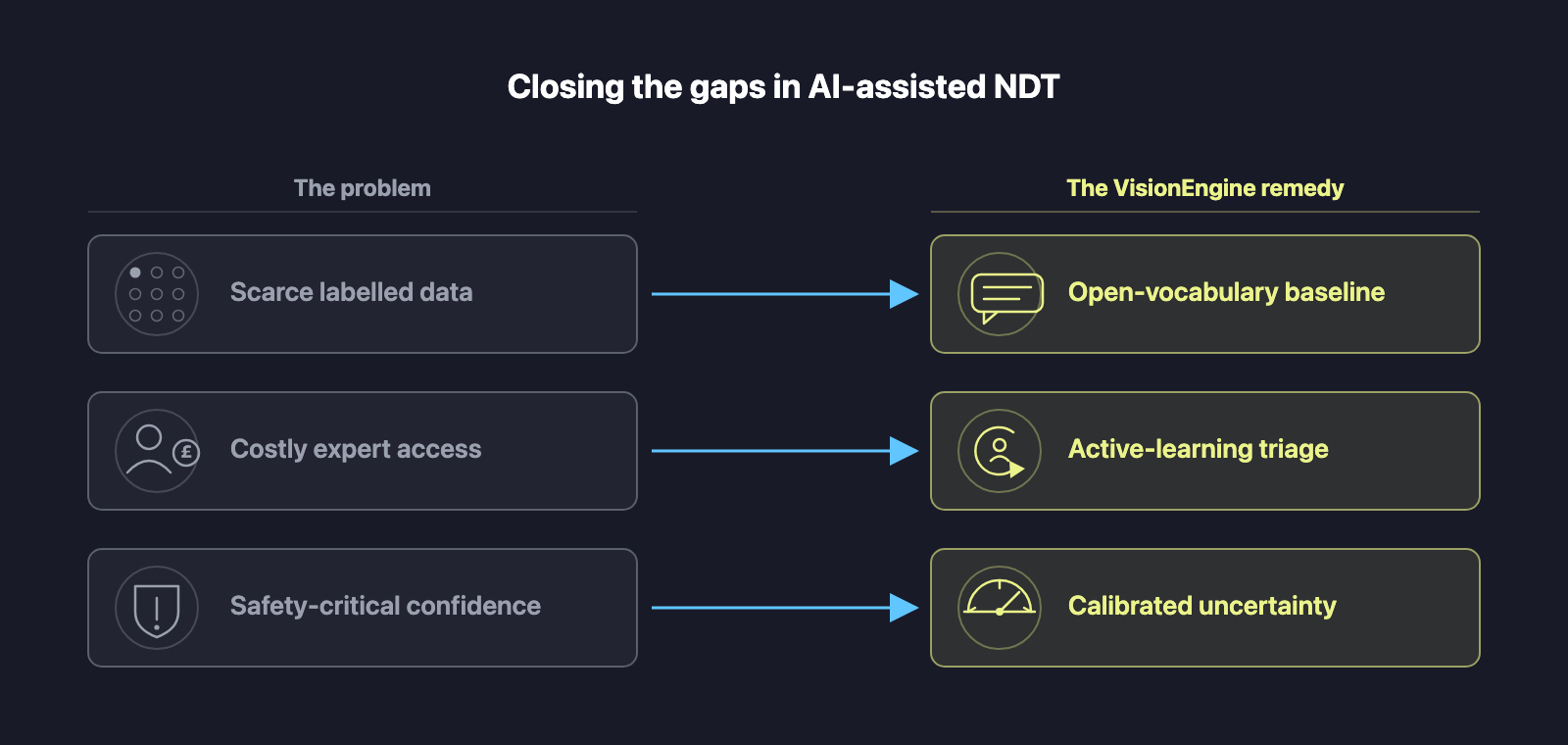
Most engineering teams that try to bring AI into their NDT programme hit the same three walls.
1. Scarce labelled data
Deep-learning folklore says you need tens of thousands of labelled examples. NDT teams rarely have them: defects are (thankfully) rare, imagery is often commercially sensitive, and historic archives are unlabelled. Open-vocabulary detection changes the starting point. Modern foundation models can detect and segment objects described in plain language — "corrosion", "weld seam", "surface crack" — with zero task-specific training. That gives you a working baseline on day one, from your own images, before a single label has been drawn. VisionEngine is built around exactly this workflow: upload images, get an instant open-vocabulary baseline, then improve it.
2. Expensive expert labelling and asset access
When training data is needed, the people qualified to label NDT imagery are the same PCN-certified inspectors whose time is scarce and expensive — and getting new imagery may mean scaffolding, confined-space entry or an outage window. The answer is to make every label count. Active learning has the model itself select the small number of images whose labels would most improve it, so experts label dozens of informative examples rather than thousands of redundant ones.
3. Safety-critical confidence
In nuclear, energy and infrastructure, "the model said so" is not an acceptable basis for a fitness-for-service decision. Regulators such as the Office for Nuclear Regulation expect risks to be reduced as low as reasonably practicable (ALARP), and any inspection aid must make its reliability visible. This is where uncertainty quantification matters: a model that reports calibrated confidence alongside each detection can route high-confidence, benign frames to automated disposition and send every low-confidence or borderline case to a qualified inspector. The human stays in the loop precisely where human judgement adds the most value — and the review burden shrinks instead of the safety case.
What AI-assisted NDT does not do
It is worth being explicit about limits. Computer vision does not replace method-qualified inspectors, does not remove the need for procedure qualification, and does not (yet) interpret raw ultrasonic A-scans or perform sizing to code acceptance criteria without human verification. Treat AI as a screening and consistency layer inside an existing certified workflow, not as a substitute for it. Teams that frame it this way tend to clear internal governance far faster, because the accountability chain is unchanged: the inspector disposition remains the record of decision.
What does a practical NDT adoption path look like?
A sensible first project looks like this. First, pick one image-rich inspection stream — drone visual survey, weld radiographs, thermographic panels. Second, run an open-vocabulary baseline over a representative batch of historic imagery and compare its flags against past inspector findings; this costs no labelling effort and tells you immediately whether the signal is there. Third, if the baseline is promising, use active learning to refine it with a small budget of expert labels. Fourth, agree confidence thresholds with your inspection authority: above the threshold, auto-disposition with audit trail; below it, human review. Fifth, measure — screening time per campaign, indications found versus missed, inspector hours redeployed to genuinely difficult calls.
Every step keeps certified people in control while the software absorbs the volume. That is the realistic shape of AI in NDT for the next decade: fewer hours spent scanning empty frames, more spent on the indications that deserve an expert eye.
Compare an AI baseline against your current NDT workflow
The fastest way to find out whether computer vision adds value to your NDT programme is to test it on your own imagery. VisionEngine gives you an open-vocabulary detection baseline on uploaded inspection images in minutes — no training data, no labelling, no integration work. Compare an AI baseline against your current NDT workflow.
Frequently asked questions
What is non destructive testing?
Non destructive testing (NDT) evaluates the integrity of a material, component or assembly without destroying its serviceability. A part that passes NDT goes straight back into service. Common methods include visual, radiographic, ultrasonic, magnetic particle, dye penetrant, eddy current and thermographic testing, most of which end in an image a person interprets.
Can AI replace a qualified inspector?
No. Computer vision does not replace method-qualified inspectors; it is a screening and review layer inside an existing certified workflow. It triages images at volume and flags candidate indications, but the inspector's disposition remains the record of decision. The accountability chain is unchanged, which is why teams clear internal governance faster.
How much labelled data do you need to start?
None. Open-vocabulary detection lets modern foundation models detect and segment objects described in plain language, such as corrosion, weld seam or surface crack, with no task-specific training. VisionEngine gives you a working baseline on day one from your own images, before a single label is drawn. You add labels later, only where they improve the model.
Where does computer vision add the most value in an NDT workflow?
An inspection campaign has four stages: capture, screening, interpretation and reporting. Computer vision earns its keep in the middle two. It triages thousands of images in minutes, flagging candidate indications so inspectors start with a ranked shortlist, and it applies the same criteria to every frame for consistent, auditable interpretation.
How do you keep AI reliable enough for safety-critical inspection?
Make reliability visible. A model that reports its uncertainty alongside each detection can route high-confidence, benign frames to automated disposition and send every borderline case to a qualified inspector. The human stays in the loop where judgement matters most, so the review burden shrinks instead of the safety case. Regulators expect risk reduced as low as reasonably practicable.