Computer vision
you can trust,
adapted to your data.
Bring 10–100 images. We run a baseline model, ask you to review just 10 labels, and show a measurably better model — before you commit to anything. Built on the same uncertainty-first principles as the Uncertainty Engine.
See the loop in action
From raw images to a measured model — in minutes.
From your images to a model you trust, in four steps.
The product is built around one promise: every loop should give you a measurably better model, without asking you to label a thousand images upfront.
The same uncertainty-first principles as the Uncertainty Engine — for vision.
Designed for the hard, high-stakes vision problems engineers actually have.
Detection and segmentation are the two task types in VisionEngine. Measurements come as a derived output of segmentation when an image has a known scale.
 electronics
 aviation
 agriculture
 energy
 materials
 life
Industry images used with attribution: AMagill (CC BY 2.0) · Jorge Láscar (CC BY 2.0) · Malcolm Neal (CC BY-SA 2.0) · Salem Ander (CC BY-SA 4.0) · Gael Guetard (CC BY-SA 4.0) · ZEISS Microscopy (CC BY 2.0) — via Wikimedia Commons and Openverse.
Notes on building vision you can trust.
Open-Vocabulary Detection: Zero-Shot Defect Finding
Open-vocabulary detection finds defects you never trained for—describe them in plain words and get an instant inspection baseline, zero labels needed.
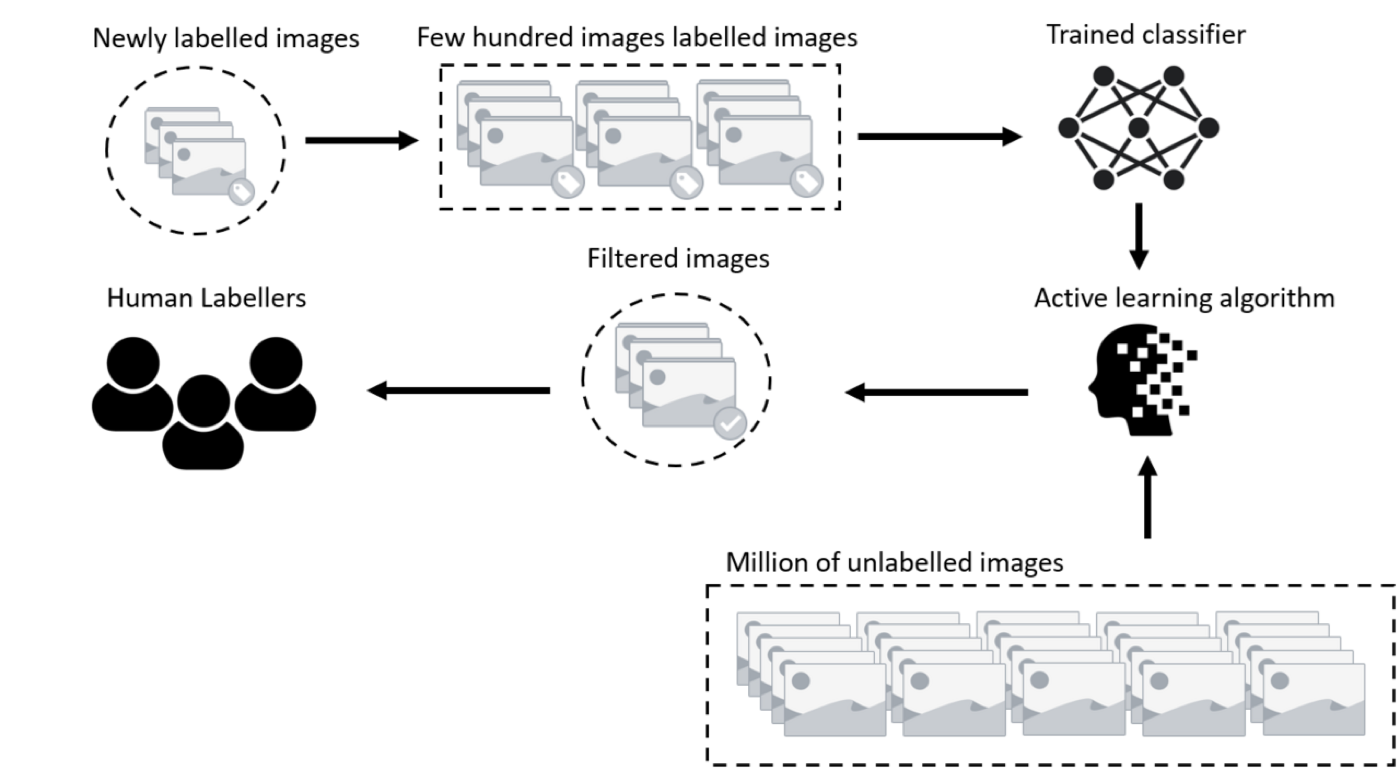
Active Learning Explained: Train With Fewer Labels
How active learning uses uncertainty sampling to train an inspection model with the fewest expert labels — a guide for engineers.
Try it on your own data.
Drop in your images. We'll show you what the baseline gets right, what it gets wrong, and exactly how much your ten corrections move the model. Then you decide.