Computer Vision Inspection vs Manual Inspection
How computer vision inspection compares with manual inspection on speed, cost and consistency — and where an uncertainty-first baseline fits.
Computer vision inspection uses cameras and machine-learning models to detect, classify and measure defects automatically, in place of or alongside a trained inspector's eye. It automates the visual-testing loop within existing NDT standards, screening large image sets at a steady, consistent rate and producing an auditable digital record.
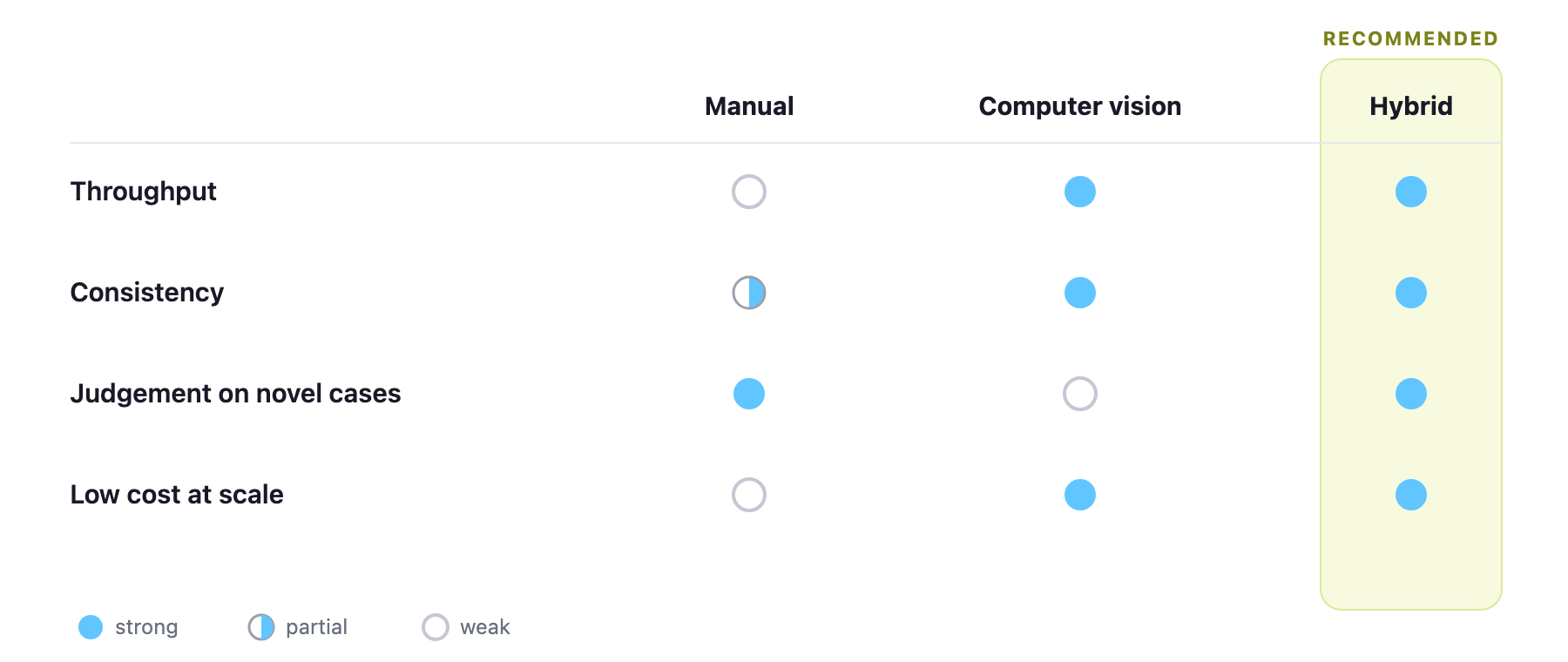
Computer vision inspection uses cameras and machine-learning models to detect, classify and measure defects automatically, whereas manual inspection relies on a trained inspector's eye and judgement. For engineering teams in nuclear, energy and infrastructure, the practical difference comes down to three things: speed, cost and consistency. A computer vision system screens large image sets at a steady rate and applies identical criteria to every frame; a skilled inspector brings context, reasoning and accountability that no model fully replicates, but works more slowly and less repeatably. This guide compares the two approaches on each dimension and shows where a hybrid, uncertainty-first workflow gives you both throughput and trust.
What is computer vision inspection?
Computer vision inspection is the use of digital imaging and machine-learning models to find and grade defects — cracks, corrosion, weld flaws, missing components — from photographs or video, in place of or alongside human visual examination. It is the automated end of the same discipline that NDT practitioners call visual testing (VT).
Visual testing is the most widely used non-destructive testing method, and it is codified in standards such as BS EN ISO 17637 for fusion-welded joints, which sets out illumination, viewing angle, personnel and record-keeping requirements. Computer vision does not replace that framework; it automates the image-capture-and-assessment loop within it, and produces a consistent digital record as a by-product.
How much faster is computer vision inspection than manual inspection?
Manual inspection is inherently serial. An inspector examines one component, weld or span at a time, and the pace is bounded by access, fatigue and reporting. On large assets — a substation, a wind farm, kilometres of pipeline — the survey itself may take days, and the write-up days more.
Computer vision changes the shape of the work. Once images or drone footage are captured, a model can screen thousands of frames in the time it takes an inspector to review a handful, flagging the regions that warrant attention. The inspector's time then shifts from searching to deciding. This is where automated visual inspection earns its place: not by removing people, but by pointing them at the few per cent of images that actually matter.
The historic catch has been that training a model to do this needed a large, labelled dataset — thousands of example images marked up by an expert — before it could detect anything at all. Modern open-vocabulary detection removes that barrier: you can describe a defect in plain language ("surface crack", "corrosion", "missing bolt") and get a usable baseline with zero training images. For teams sitting on scarce labelled data, that is the single biggest change of the last few years.
What does computer vision inspection actually cost?
The obvious cost of manual inspection is inspector time, but it is rarely the largest line. Asset access dominates: scaffolding, rope access, confined-space entry, road or line possessions, generator outages and, in nuclear, radiological dose managed under the ALARP principle. Every hour an expert spends physically at the asset is expensive and sometimes hazardous.
Computer vision shifts cost away from access and towards data handling. Images can be gathered quickly — often by drone or a technician with a camera — and the expensive expert is brought in only to adjudicate the uncertain cases, remotely. The expert-labelling cost that machine vision defect detection has traditionally required is also reducible: active learning lets the system ask for the fewest, most informative labels, so an engineer confirms a handful of borderline examples rather than annotating a whole dataset. The result is that automated quality inspection spends expert time on judgement, not on repetitive labelling.
Consistency: the human-factors problem
This is the dimension where the gap is widest, and it is well documented. The reliability of visual inspection is described by its probability of detection (POD) — the likelihood that a flaw of a given size is found — and POD is strongly affected by human factors: inspector experience, fatigue, lighting, ease of access and even the order in which items are examined. Two competent inspectors can return different findings on the same weld, and the same inspector can differ from themselves at hour eight of a shift.
A model does not tire and does not drift. It applies the same threshold to image one and image ten thousand, which makes its output auditable and repeatable in a way human inspection cannot match. That consistency is exactly what quality and regulatory regimes reward, because it makes performance measurable.
The counter-argument matters too, and it is a safety one: a model that is consistently wrong is worse than a human who is occasionally right. A detector applied outside its competence will miss defects with the same steady confidence it applies to everything else. This is why raw automation, on its own, is the wrong goal for safety-critical work.
Where does manual inspection still win?
Human inspectors remain better at novel, ambiguous or context-dependent findings — the corrosion pattern that implies a drainage fault upstream, the hairline indication that only makes sense given the component's service history. They adapt to conditions a model has never seen, and they carry accountability that a regulator can name. For final sign-off on safety-critical items, that judgement is not optional, and standards such as BS EN ISO 17637 and personnel-certification schemes like BINDT's PCN exist precisely to underwrite it.
The honest conclusion is not "computer vision beats manual inspection". It is that each is strong where the other is weak.
A hybrid, uncertainty-first approach
The workflow that gets the best from both starts from the machine and escalates to the human. A model produces a first-pass baseline across every image; it attaches a calibrated confidence to each finding; and it routes only the low-confidence cases — the genuine grey areas — to a qualified inspector. High-confidence passes and high-confidence defects are handled automatically and logged; the expert's scarce time is spent where uncertainty is real.
That uncertainty quantification is the part most often missing from off-the-shelf machine vision, and it is the part that makes automation defensible in a nuclear, energy or infrastructure setting. It turns "the model said so" into "the model was confident here, and flagged these twelve images for you". Combined with an open-vocabulary starting point (no training data required) and active learning (the fewest expert labels), it gives you speed and cost savings without asking you to trust a black box on safety-critical calls. The same principles underpin modern AI defect detection more broadly.
Estimate your inspection time saved
If your current process is a skilled inspector reviewing every image by hand, the fastest way to see the difference is to run an automated baseline over a real set of your own inspection photos — then count how many the model clears with high confidence, and how few genuinely need your expert's eye.
Run a free baseline and estimate your inspection time saved →
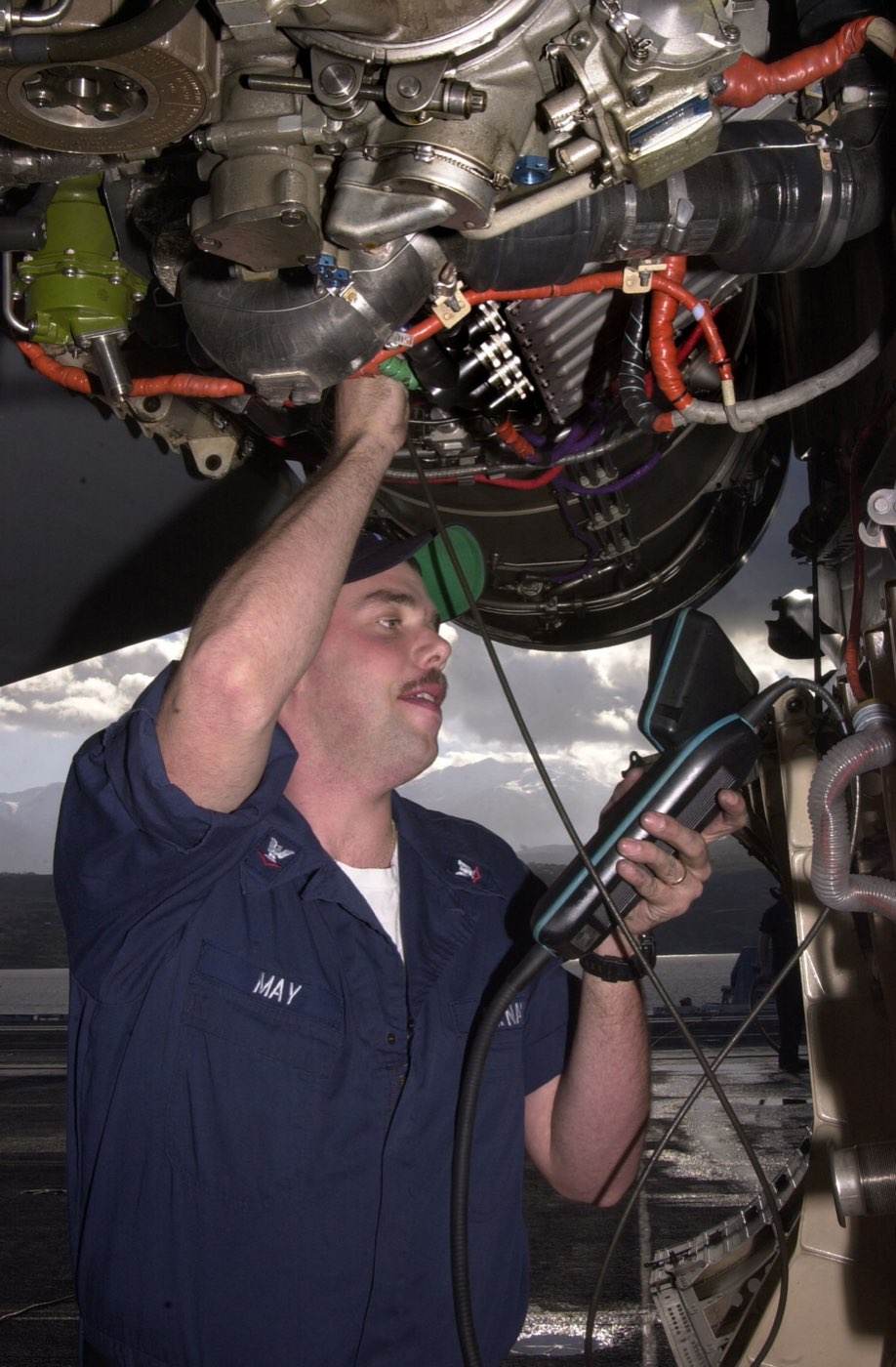
Hero image — Manual inspection with a video borescope — U.S. Navy photo · Public domain · Wikimedia Commons.
Frequently asked questions
Can AI replace a qualified inspector?
No. Computer vision inspection is a screening and review layer, not a replacement. A model clears high-confidence images and flags the genuine grey areas, but a qualified inspector still adjudicates ambiguous findings and signs off safety-critical items. The workflow is human-in-the-loop by design, which is what regulators and certification schemes require.
How much labelled data do you need to start?
None. An open-vocabulary baseline lets you describe a defect in plain language — 'surface crack', 'corrosion', 'missing bolt' — and get usable detections with zero training images. From there, active learning asks for the fewest, most informative labels, so an engineer confirms a handful of borderline cases rather than annotating a whole dataset.
Is computer vision inspection more consistent than manual inspection?
Yes, and consistency is where the gap is widest. A model applies the same threshold to image one and image ten thousand; it does not tire, drift or vary with lighting or shift length. Manual probability of detection is strongly affected by human factors, so two competent inspectors can return different findings on the same weld.
How does computer vision inspection reduce inspection cost?
It shifts cost away from asset access — scaffolding, rope access, confined-space entry, outages and radiological dose — and towards data handling. Images can be gathered quickly by drone or a technician with a camera, and the expensive expert is brought in only to adjudicate the uncertain cases, usually remotely.