Active Learning Explained: Train With Fewer Labels
How active learning uses uncertainty sampling to train an inspection model with the fewest expert labels — a guide for engineers.
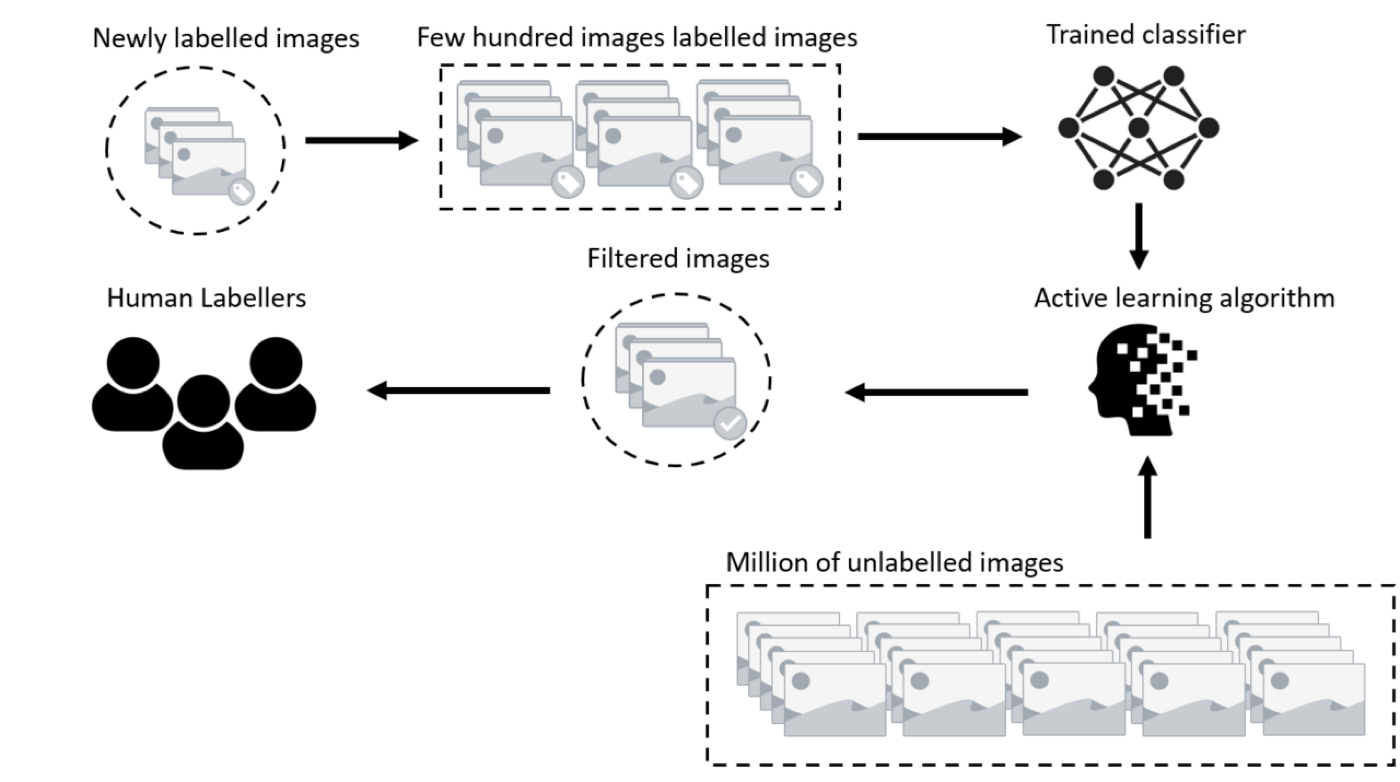
Active learning is a machine-learning approach for training a computer vision model with far fewer labelled images. The model ranks unlabelled images by uncertainty and asks a human to label only the few it finds hardest to call, so accuracy climbs while labelling effort stays low.
Active learning is a way to train a computer vision model using far fewer labelled images than conventional supervised learning. Instead of labelling thousands of images up front, the model chooses the handful of examples it is least certain about and asks an engineer to label only those. Each label it requests is the one expected to improve the model most, so accuracy climbs quickly while your labelling effort stays low. For inspection teams working with scarce data and expensive expert time, that is the difference between a model that takes months to prepare and one that reaches a usable baseline in an afternoon.
Active learning is a machine-learning approach in which the model iteratively selects the most informative unlabelled examples for a person to label, rather than learning from a fixed, randomly chosen training set. In computer vision, that usually means ranking your unlabelled images by uncertainty and requesting labels only for the ones the model finds hardest to call.
Why is labelling the real bottleneck?
For most engineering inspection problems, the shortage is not images — it is labelled images. A drone survey or a borescope run can produce thousands of frames in a day. Turning those frames into training data means someone has to draw the boxes or masks and say, correctly, "this is leading-edge erosion" or "this is corrosion under insulation, not surface staining."
That someone is usually a qualified inspector. The people who can reliably distinguish a genuine weld defect from an acceptable indication are certified professionals — for example, those holding PCN certification administered by The British Institute of Non-Destructive Testing. Their time is scarce and expensive, and in many settings the assets themselves are hard to reach: pressurised systems, live overhead lines, radiological areas, or subsea structures you can only inspect during a planned outage.
So the real cost of a conventional supervised model is not compute. It is thousands of hours of expert labelling on data that is often hard to gather in the first place. Active learning attacks exactly that cost by being deliberate about which images are worth an expert's attention.
How does active learning work?
Active learning runs as a loop rather than a one-off training job:
- Start from a baseline model. With an open-vocabulary detector you can begin with zero labelled examples, using a text prompt such as "surface crack" or "corrosion" to get a first, rough set of detections.
- Score every unlabelled image by how informative it would be to label.
- Send only the top-ranked images to an engineer to label or correct.
- Add those new labels and update the model.
- Repeat until performance plateaus or you hit your accuracy target.
The clever part is step 2 — the query strategy that decides which images to ask about.
Uncertainty sampling
The most widely used query strategy is uncertainty sampling: the model requests labels for the examples it is least confident about. For a two-class decision, that means images where the predicted probability sits closest to 0.5 — right on the decision boundary. For multi-class problems, common measures are least confidence (the top prediction is still weak), margin (the gap between the two most likely classes is small), and entropy (the prediction is spread across several classes).
The intuition is straightforward for any engineer who has done root-cause work. You learn most from the ambiguous, borderline cases, not from the obvious ones. A clearly sound weld and a textbook lack-of-fusion tell the model little it does not already know; the marginal, "could go either way" image is where a single expert label sharpens the boundary the most.
Other query strategies
Uncertainty alone can be greedy — it may keep asking about a cluster of near-identical frames from the same asset. In practice, effective active learning blends uncertainty with diversity (or representativeness) sampling, so the queued batch covers different assets, lighting and defect types rather than fifty views of the same joint. Query-by-committee, where several models vote and disagreement flags an image, is another established approach. The goal in every case is the same: spend each label where it buys the most improvement.
Keeping the expert in the loop
Active learning is a form of human-in-the-loop labelling. The model never labels the training set on its own; it narrows the field so the expert reviews the few images that matter and skips the thousands that are already easy calls. That keeps a qualified person accountable for every judgement that feeds the model — which is exactly what a safety-critical inspection regime demands.
The same uncertainty signal that drives labelling is also what you want at inference time. In a safety-critical setting you cannot treat a low-confidence automated call the same as a high-confidence one. The defensible pattern is to let the model clear the obvious cases and route only the uncertain ones to a human — a natural fit with the ALARP principle and the expectations set out by the Office for Nuclear Regulation. This confidence-first idea is worth a post of its own, and uncertainty quantification for safety-critical inspection is the natural next topic in this series. For the wider context, see our guide to automated visual inspection.
Active learning in a VisionEngine workflow
VisionEngine is built around this loop. You upload your images and get an instant open-vocabulary detection and segmentation baseline — no training data required — so you have something to react to on day one, addressing the scarce-labelled-data problem directly. The system then ranks your images by uncertainty and surfaces the most informative ones for review. You confirm or correct those few labels, and the model retrains. Because you only ever label what the model asks for, expert effort goes to the images that move accuracy the most.
That is the whole promise of active learning for computer vision: reach a working, auditable baseline with a fraction of the labelling a from-scratch model would need, then improve it in short, cheap iterations rather than one enormous annotation project.
What should you expect from active learning in practice?
Active learning is well established in the machine-learning literature, and the consistent finding is that a model trained on carefully chosen examples can reach the accuracy of one trained on a much larger, randomly labelled set — often using only a small fraction of the labels. The exact saving depends on your data, so treat it as a method that reliably reduces labelling effort rather than a fixed percentage.
A few practical points worth planning for. Rare defects create class imbalance, so pair uncertainty sampling with targeted prompts to make sure genuine defect examples reach the queue. Label in small batches and retrain between them, rather than committing to one large batch, so the query strategy stays informed by the latest model. And keep a held-out validation set that the model never gets to query, so your reported accuracy reflects real performance and not the examples the model found easiest.
Used this way, active learning turns image labelling from a months-long overhead into a short, focused task — the fewest, most informative labels, chosen by the model, confirmed by your experts.
Frequently asked questions
What is active learning?
Active learning is a training strategy where the model selects the most informative unlabelled images for a person to label next, rather than labelling data at random. In computer vision that means ranking images by uncertainty and requesting labels only for the ones the model finds hardest to call.
What is uncertainty sampling?
Uncertainty sampling is the most common active-learning rule: the model requests labels for the examples it is least confident about, because correcting those teaches it the most. For a two-class decision that means images near the 0.5 boundary; for multi-class problems, measures like least confidence, margin and entropy flag the ambiguous cases worth an expert's review.
Can AI replace a qualified inspector?
No. Active learning keeps a human in the loop: the model narrows thousands of images down to the few uncertain cases, but a qualified inspector still makes and owns every judgement that feeds the training set. The model is a screening and review layer that clears the obvious calls, not a replacement for certified expertise.
How much labelled data do you need to start?
None to begin. With an open-vocabulary baseline you can start from zero labelled examples, using a text prompt such as 'surface crack' or 'corrosion' to get a first rough set of detections on day one. From there you confirm or correct only the images the model flags as uncertain, so labelling stays light throughout.
How many labels does active learning save?
It depends on your data, so treat it as a method that reliably reduces labelling effort rather than a fixed percentage. The established finding is that a model trained on carefully chosen examples can match one trained on a much larger, randomly labelled set, often using only a small fraction of the labels.